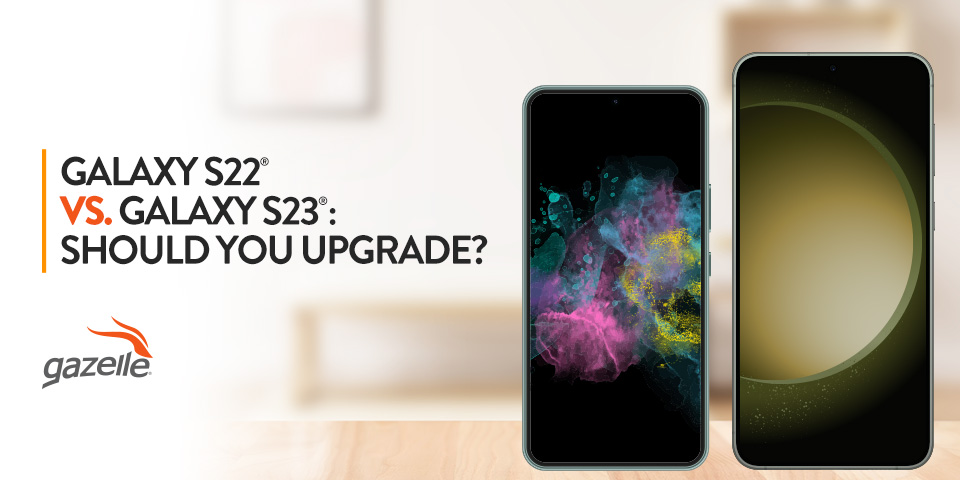

If you’re a tech enthusiast, it’s no secret that Samsung’s Galaxy S series is one of the most popular and talked-about smartphone lines on the market. With the Galaxy S22 and Galaxy S23 still circulating as used and refurbished options in 2026, buyers are weighing up which one has better value. While neither is Samsung’s latest flagship, the differences between them are worth understanding before spending your money. In this post, we’ll take a deep dive into the features that matter most for the Galaxy S22 and Galaxy S23 so you can make a well-educated choice on which one is the right fit.
Samsung Galaxy S22 vs Samsung Galaxy S23
The Samsung Galaxy S22 and Galaxy S23 are two of Samsung’s most well-known smartphones. While the S24 and S25 have since arrived, the S22 and S23 remain popular options for budget-conscious buyers looking for a premium Android experience at a lower price point. Let’s talk about how the two compare side-by-side.

Design and Display
Both phones feature sleek, premium designs with punch-hole AMOLED displays. The Galaxy S22 comes in at 6.1 inches while the Galaxy S23 bumps that up slightly to 6.2 inches – a nearly identical footprint. One notable difference is peak brightness: the S22 tops out at 1,500 nits, but the S23 reaches as high as 1,750 nits, which makes it noticeably easier to read outdoors in direct sunlight. Both displays share the same 2400 x 1080 resolution and adaptive refresh rate technology.
Camera
The camera systems on the Galaxy S22 and Galaxy S23 are actually quite similar on paper. Both phones feature a 50MP primary sensor, a 12MP ultrawide camera, and a 10MP telephoto sensor on the rear, plus a 10MP front-facing camera. The difference comes down to processing. The S23’s Snapdragon 8 Gen 2 chipset enables better computational photography, resulting in improved low-light performance and dynamic range. So while the hardware specs look identical, the S23 produces better photos thanks to its superior image processing engine.
Performance
Performance is where the Samsung Galaxy S23 pulls ahead most. The S23 is powered by the Snapdragon 8 Gen 2 “for Galaxy,” a custom-tuned variant with the primary Cortex-X3 core clocked at an elevated 3.6GHz – faster than the standard 3.2GHz configuration found in other devices using this chip. The Galaxy S22, by comparison, runs on the Snapdragon 8 Gen 1 or Exynos 2200 depending on region. The generational leap in performance is significant, with the S23 delivering faster app loading, smoother multitasking, and better power efficiency.
Battery life also sees a modest but welcome improvement. The S23 carries a 3,900 mAh battery, up from the S22’s 3,700 mAh. The S23 Plus similarly upgrades from 4,500 mAh to 4,700 mAh. That said, wired and wireless charging speeds are identical between the two generations – the S22 and S23 charge at 25W wired and 10W wireless. Both the Plus models of both generations support 45W wired charging. If battery life is a top priority for you, it’s worth comparing these numbers against other flagship options as well.
Features and Software Support
Both phones support 5G connectivity, under-display fingerprint scanning, and Samsung’s One UI software. However, software lifespan is a slight benefit for the S23. Samsung committed to four years of Android OS updates for the S23 series, which means it will receive updates through Android 17. The S22, on the other hand, is set to receive updates through Android 16 – still a respectable run, but one generation shorter. For buyers who want to hold onto their phone longer without losing security patches and new features, the S23 has a clear edge.
Price
With the S24 and S25 now on the market, the S22 and S23 can be found at lower prices – especially when buying certified pre-owned. The S22 offers outstanding value for users who don’t need the latest performance or maximum software lifespan. The S23 is usually worth the small price premium given its faster processor, brighter display, better camera processing, and an extra year of software support. For most buyers comparing these two models, the S23 is the better long-term investment.
Is it Worth it to Upgrade?
The Galaxy S22 and S23 share more in common than you might think – both feature 50MP primary sensors, 12MP ultrawide cameras, and 10MP telephoto lenses, alongside identical wired and wireless charging speeds (25W/10W on the base models, 45W/10W on the Plus variants). That said, there are actual differences worth thinking about. The S23’s Snapdragon 8 Gen 2 “for Galaxy” is clocked higher than the standard version at 3.6GHz, delivering a big performance bump over the S22. The S23 also edges ahead with a slightly bigger battery – 3,900 mAh vs. the S22’s 3,700 mAh – and a brighter display, peaking at 1,750 nits compared to the S22’s 1,500 nits.
Perhaps the strongest long-term argument for upgrading is software support. Samsung’s update policy means the S23 will receive updates through Android 17, but the S22 will cap out at Android 16. If you’re looking to hold onto your phone for a few more years, that extra generation of support could make a difference in security and feature access. But if lifespan, brightness, and processing power matter to you, the S23 is the stronger long-term investment.
Upgrade for Less with Gazelle
Are you ready to upgrade to the Samsung Galaxy S22 or Galaxy S23? Gazelle has a giant inventory of refurbished Samsung smartphones so you can get a great deal without sacrificing quality. Check out our site and start saving!